

We have all been there. You land on a new site, looking for a quick answer, and a wall of grey text blocks your path. Without a second thought, you click the brightest, largest button “Accept All” and move on.
As a digital experience enthusiast, I see this interaction not as a sign of successful data collection, but as a symptom of a broken system. Most users don’t actually consent to cookies; they simply want the banner to go away. We are witnessing the digital equivalent of muscle memory, where half of all cookie acceptances happen out of pure habit rather than informed choice.
The Illusion of Preference
There is an uncomfortable truth in our industry: most websites aren’t just counting on this habit, they are designing for it. When we look at the data, the “choice” users make is almost entirely dictated by the friction we place in front of them.
The data paints a clear picture of design-induced consent. I came across a landmark study by researchers from MIT and Aarhus University (Nouwens et al., 2020) which demonstrated that when rejection is buried in sub-menus, acceptance rates skyrocket to as high as 90%. Conversely, findings from the French regulator CNIL suggest that when ‘Reject All’ is given equal prominence, (same size, color, and positioning) nearly 60% of users choose to opt-out. This isn’t a change in user preference; it’s a change in the friction they are willing to endure.
The Rise of "Consent or Pay": Privacy as a Premium Feature?
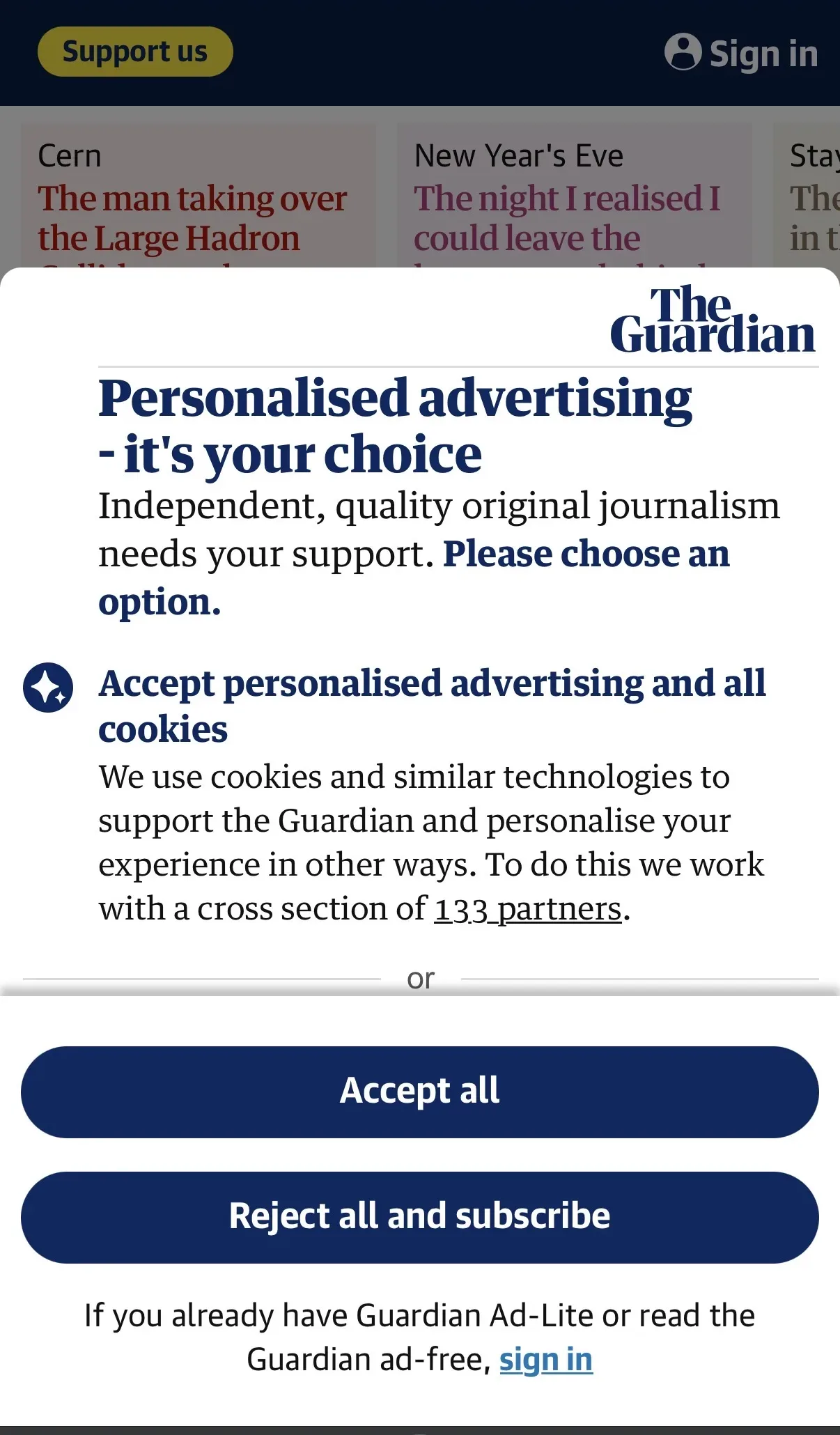
As regulators tighten the screws on dark patterns, a more aggressive tactic has emerged on high-traffic sites like The Guardian: the “Consent or Pay” (or in this case ”Consent or Reject all and Subscribe”) model.
The value exchange is made explicit: you either consent to being tracked for personalized ads, or you pay a monthly subscription fee to keep your data private. According to a deep dive by WP Legal Pages, this model is technically legal under GDPR, but it walks a razor-thin legal tightrope regarding what “freely given” consent actually means.
I came across a recent opinion from the European Data Protection Board (EDPB) which argues that for large platforms, this binary choice often fails the test of valid consent. However, the UK’s Information Commissioner’s Office (ICO) has taken a more pragmatic view, stating in their updated 2025 guidance that these models can be compliant if the fee is appropriate and the service remains equivalent.
The 15% Problem: A Crisis of Compliance
It is scary to realise how far the industry has strayed from the legal intent of privacy laws. I came across a study of 254,000 websites which found that a staggering 85% of cookie banners fail to meet basic GDPR requirements.
In 2022, French regulators issued fines to tech giants exceeding €150 million specifically because they made the rejection process significantly harder than acceptance. This was a landmark moment for UX ethics; it signaled that “dark patterns” were no longer just a design issue, they were a legal liability.
The Geographic Split: A Tale of Two Internets
The most telling evidence that consent is a product of design and regulation is the geographic divide. According to industry benchmarks:
| Region | Avg. Acceptance Rate | The Behavioral Driver |
| Germany & France | <25% | Strict enforcement and high privacy awareness. |
| USA | >80% | Opt-out culture and design favoring “Accept” paths. |
| Nordic Countries | 72-82% | Ethical trust and transparent design. |
What Actually Works: The Nordic Model
Nordic countries prove that you don’t need dark patterns to get data. They achieve high consent rates with fully compliant, ethical designs. By using two buttons of the same size, same color intensity, and same position, they treat “Accept All” and “Reject All” as genuinely equal choices. When you respect users with clarity, many of them choose to stay.
The Future: Browser-Level Consent
The era of “tricking” users into tracking is ending. The EU is pushing toward browser-level signals where you set your preferences once no more banners (The irony of citing The Guardian as the source after navigating their paywall). While Google continues to delay the end of third-party cookies, browsers like Safari and Firefox have already moved ahead, blocking them by default.
My Prescription
- UX Designers: Make "Reject" and "Accept" genuinely equal. If you are proud of your product, you shouldn't need to hide the exit.
- Marketers: Invest in first-party data. A user who trusts you enough to share their info is worth a thousand users who "accidentally" accepted a cookie.
- Product Managers: Build for a cookieless future. Your product's core value should never depend on a dark pattern.
The cookie consent paradox isn’t that users don’t care about privacy, it’s that we’ve designed systems that exploit their fatigue. It is time we start earning trust through respect.